Initiatives for Environment
Basic Policy
In response to effective usage of limited resources and aggravation of climate change issue, JHR and JHRA work on monitoring environmental performance, such as energy consumption, CO2 emissions, water consumption and amount of waste generated, etc. and strive to improve them continuously.
Environmental Target
We have set targets to reduce GHG emissions intensity(*1) for long term until 2050.
- 30% reduction of GHG emissions per floor area in our portfolio (GHG emissions intensity) compared to FY2017(*2).
- To monitor and manage progress towards long-term target and to comprehend the causes of variance in emissions at the "ESG Promotion Committee" of JHRA.
| (*1) |
The GHG emissions of JHR fall under Scope 3 emissions, Category 13: leased assets (downstream) because the hotels in our portfolio are managed by lessees of hotels, etc. |
| (*2) |
The GHG emissions intensity for the baseline year, FY2017 (April 2017 to March 2018) was 0.135 (t-CO2/㎡). |
Environmental Performance Data
| (*1) |
The data coverage ratio represents the proportion of the total floor space of properties for which data could be obtained compared to the total floor space of properties owned during the subject period. The floor space of properties acquired or sold during the subject period is calculated based on the proportionally distributed floor space corresponding to the properties owned. |
| (*2) |
Properties owned by JHR are managed by hotel lessees, etc. and the above data is based on the data provided by hotel lessees, etc. |
| (*3) |
Amount of CO2 emissions are calculated based on "Institution of calculation, reporting and disclosure of amount of emissions by greenhouse effect gas" established by Ministry of the Environment. |
| (*4) |
Figures may change due to revisions in the aggregation method and other factors. |
| (*5) |
The data for waste for the base year is a reference value compiled by the Asset Management Company. |
Actual Cases of Initiatives for Environment
●Switching to LED lighting
We are striving to reduce electricity consumption by switching from conventional lighting to LED lighting at some of the hotels in our portfolio.
-
Oriental Hotel Hiroshima
-
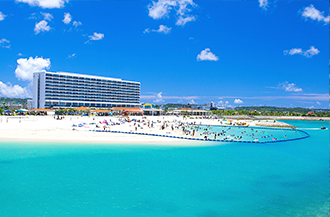
Oriental Hotel Okinawa Resort & Spa

●Introduction of water-saving devices
We strive to reduce water consumption through installing water-saving devices for a restroom, a tap in the kitchen, etc. to adjust water use amount properly.
●Renewal of air conditioners
We reduce electricity consumption by installing inverter control devices on air conditioners for better operational efficiency.
●Reuse of water
Several of our hotels reduce clean water consumption by using well water instead. Some of our hotels in Okinawa are working on to reduce clean water consumption by reusing gray water as recycled water.
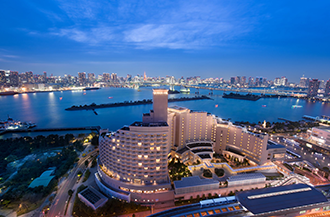
At Oriental Hotel Tokyo Bay and Hilton Tokyo Odaiba, wastewater generated from the hotels (approximately 80 tons per day) is purified and reused for toilet flushing and watering flower beds.
 Hilton Tokyo Odaiba
●Utilization of energy-saving subsidies
Some of our hotels have been utilizing energy-saving subsidies to reduce energy consumption by introducing equipment with superior energy efficiency.
In March 2024, Kobe Meriken Park Oriental Hotel received a subsidy from the Ministry of Economy, Trade and Industry for Energy Conservation Investment Promotion Support Program to upgrade its heat source equipment.
In March 2024, International Garden Hotel Narita received a subsidy from the Japan Federation of Johkasou Associations for a CO2 emission reduction project and carried out renovation work on the septic tank facilities.
●Green Leases
In order to promote environmentally friendly initiatives in our portfolio, we have signed green lease clauses with the lessees, including HMJ Group hotels, one of our major hotel groups. Under the clauses, JHR analyzes energy data, among other things, considering renovations to improve environmental performance and working to optimize the operation of facility management. For hotels, these efforts can lead to reduced utility expenses through improved environmental performance.
Green Lease track record (as of the end of June 2026)
| No. of Properties |
Proportion of Total Floor Area |
| 34 |
80.9% |
●Green Building Certifications by third-party institutions
In order to confirm the credibility and objectivity of our initiatives aimed at reducing our environmental impact, we have obtained Green Building Certifications from third-party institutions.
Green Building track record (as of the end of June 2026)
| No. of Properties |
Proportion of Total Floor Area |
| 18 |
60.7% |
■CASBEE Certification for Buildings
"Comprehensive Assessment System for Built Environment Efficiency (CASBEE)" is a method for evaluating and rating the environmental performance of buildings. It is a system to comprehensively evaluate the quality of buildings, including interior comfort and landscape considerations, as well as environmental considerations such as energy conservation and the use of materials and equipment with low environmental loads.
CASBEE for Buildings (Existing Buildings) is an evaluation method which targets buildings with an operational record of at least one year after completion, and assesses buildings based on annual performance of operations, deterioration of buildings and interior environments. Assessment results by CASBEE are indicated in a scale with the following five ranks: "S: Superior," "A: Very Good," "B+: Good," "B-: Slightly Poor," and "C: Poor."
See here for details of CASBEE
http://www.ibec.or.jp/CASBEE/english/index.htm
Oriental Hotel Fukuoka Hakata Station
Hilton Tokyo Odaiba
HOTEL AMANEK Shinjuku-Kabukicho.
■DBJ Green Building Certification
The DBJ Green Building Certification is a system established by the Development Bank of Japan Inc. (DBJ) to support environmentally and socially conscious real estate ("Green Buildings").
The system evaluates and supports real estate that meets the needs of society and the economy, based on a comprehensive assessment, which includes not only the environmental performance of properties but also disaster prevention measures, community engagement and consideration for various stakeholders.
Since its inception in 2011, the certification has been applied to four property types: offices (Office Version), logistics facilities (Logistics Version), retail facilities (Retail Version) and residential buildings (Residential Version). In April 2024, DBJ newly introduced a "Hotel Version" of its Green Building Certification.
See here for details of DBJ Green Building Certification
https://igb.jp/en/index.html
Hilton Tokyo Narita Airport
International Garden Hotel Narita
Hotel Nikko Nara
Kobe Meriken Park Oriental Hotel
Oriental Hotel Tokyo Bay
Oriental Hotel Okinawa Resort & Spa
Hotel Oriental Express Fukuoka Tenjin
MIMARU Tokyo Shinjuku West
Hilton Tokyo Bay
Hilton Fukuoka Sea Hawk
OKINAWA HARBORVIEW HOTEL
Southern Beach Hotel & Resort OKINAWA
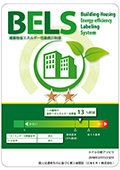
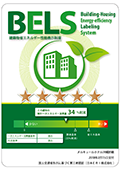
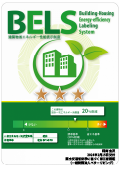
■BELS (Building-Housing Energy-efficiency Labeling System) Evaluation
"BELS" is a public valuation and display system under a guideline by the Ministry of Land, Infrastructure, Transport and Tourism to evaluate the energy conservation performance of each building, which was launched in April 2014. A third-party institution verifies the energy performance of a building by evaluating its primary energy consumption and labels the performance of both new and existing buildings.
The evaluation result is presented using the five-star scale (from "★" to "★★★★★") that was applied under the BELS scheme in effect at the time, as all of our labels were obtained prior to March 2024.
See here for details of BELS (Japanese only)
https://www.hyoukakyoukai.or.jp/bels/info.html
Hotel Nikko Alivila
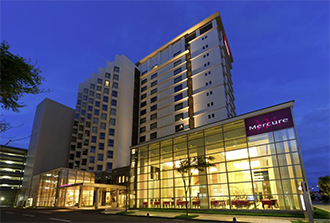
Mercure Okinawa Naha
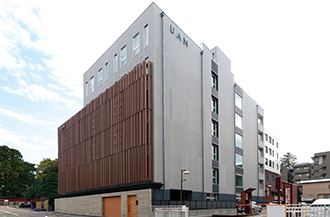
UAN kanazawa
●Introduction of eco-friendly laundry facilities
In July 2024, Oriental Hotel Tokyo Bay introduced the "wash+ Comfort," an eco-friendly washer-dryer that enables laundry without detergent, using only alkaline ionized water. As it does not require detergent, it is allergen-free and gentle on the skin. Additionally, the absence of rinsing process enhances water conservation and reduces wastewater pollution, contributing to lower environmental impact. The machine also features a touchscreen for checking wait times and availability, and supports cashless payments via smartphone, enhancing user convenience.
In December 2024, Namba Oriental Hotel established a Laundry Lounge and similarly introduced the eco-friendly "wash+ Comfort" washer-dryer.
-
 Oriental Hotel Tokyo Bay
-
 Namba Oriental Hotel
●Introduction of wooden room keys
As part of efforts to reduce environmental impact, Hilton Tokyo Odaiba and OKINAWA HARBORVIEW HOTEL have transitioned from conventional plastic room keys to environmentally friendly wooden rook key cards.
 OKINAWA HARBORVIEW HOTEL
●Food waste reduction
HMJ Group hotels, including Hilton Narita and International Garden Hotel Narita, are gradually implementing Winnow's AI-powered "Food Waste Solution," a tool designed to visualize and track food waste.
This system accurately measures the weight and type of discarded food, allowing for data-driven improvements in procurement and cooking methods.
Additionally, Hilton Narita has launched the "Ethical Box" initiative for guests attending the second session of the lunch buffet. This service allows guests to take home uneaten food from their plates or untouched dishes from the buffet in designated takeaway boxes. This initiative helps reduce food waste and promotes responsible consumption.
-
 HMJ Group Hotel
-
 Hilton Narita
●Greenhouse gas reduction
At Hilton Tokyo Odaiba, an EV turbo charging station has been installed in the underground parking lot. Furthermore, starting in May 2024, the hotel launched a car-sharing service with zero emission electric vehicles, contributing to sustainable mobility.
 Hilton Tokyo Odaiba
●Plastic and waste reduction (HMJ group hotels)
The HMJ Group hotels are transitioning from disposable plastic amenities such as toothbrushes and hairbrushes to biomass-based alternatives made with discarded rice and other sustainable materials.
Plastic straws and cutlery have been phased out in favor of wooden cutlery made from thinned wood and biomass straws.
-
 Oriental Hotel Tokyo Bay
-
 Oriental Hotel Okinawa Resort & Spa
Individual packaging for in-room shampoo, conditioner and body soap is being replaced with refillable pump bottles.
-
 Oriental Hotel Tokyo Bay
-
 Hilton Tokyo Odaiba
At Oriental Hotel Tokyo Bay and Oriental Hotel Okinawa Resort & Spa, some in-room amenities have been removed, and guests can now select the items they need from newly established amenity stations by JHR.
-
 Oriental Hotel Tokyo Bay
-
 Oriental Hotel Okinawa Resort & Spa
At Hilton Narita and International Garden Hotel Narita, plastic bottles have been eliminated as part of plastic reduction efforts. Water dispensers have been installed on each floor, and pitchers are provided in guest rooms.
At Hilton Tokyo Odaiba, water dispensers have been installed for employees, encouraging the use of personal bottles as part of a collective effort to reduce plastic waste.
In addition, at OKINAWA HARBORVIEW HOTEL, the hotel shop sells original reusable bottles to promote reduced use of plastic bottled water.
-
 Hilton Narita
-
 OKINAWA HARBORVIEW HOTEL
●Sakura Quality An ESG Practice
Hotel Nikko Alivila, Hotel Nikko Nara and Hotel JAL City Kannai Yokohama have acquired “Sakura Quality An ESG Practice (commonly known as “Sakura Quality Green”),” an international certification for accommodations that practice SDGs.
“Sakura Quality An ESG Practice” is an international standard approved by the Global Sustainable Tourism Council (GSTC) in the United States, and serves as a quality certification system for accommodations focused on SDGs.
- Hotel Nikko Alivila

- Hotel Nikko Nara

- Hotel JAL City Kannai Yokohama

●Green Key
Green Key is an international eco-certification program awarded to hotels and other accommodation facilities, etc. that operate in an environmentally responsible manner. It originated in Denmark in 1994 and is currently operated by the Foundation for Environmental Education (FEE).
As part of the certification process, facilities are evaluated on a range of criteria, including environmental management, energy efficiency, waste management, water conservation and other sustainability initiatives.
- Mercure Sapporo

- ibis Styles Kyoto Station

●Investing in mixed-use buildings
We are investing in mixed-use facilities that fall within the scope of our asset management, as stipulated in the Articles of Incorporation.
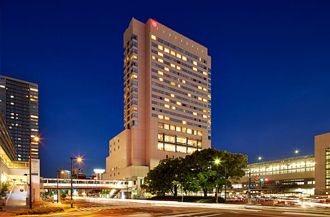
ACTIVE-INTER CITY HIROSHIMA
(Sheraton Grand Hiroshima Hotel)
High-rise hotel and office tower within ACTIVE-INTER CITY HIROSHIMA, a mixed-use facility comprised of hotels, offices, and commercial facilities located next to JR Hiroshima Station.
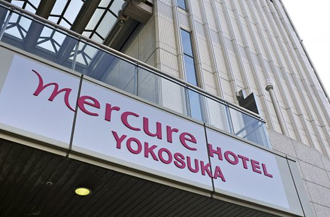
Mercure Yokosuka
High-rise hotel within Bay Square Yokosuka Ichibankan in Yokosuka city. Bay Square Yokosuka Ichibankan is a landmark mixed-used facility consist of hotel, Yokosuka Arts Theatre, Yokosuka Industrial Community Plaza, etc.
●Investing in urban redevelopment
We are investing in urban redevelopment projects.
Oriental Hotel Fukuoka Hakata Station
Hotel located next to the JR Hakata Station Chikushi Exit rotary and connected to the Hakata Station subway station via an underground passage. In the vicinity of Hakata Station, a station-front plaza redevelopment project is under way, for which we carried out renovation work including for a corridor extending from the underground passage to the aboveground entrance/exit.
Initiatives for Climate Change
Our (JHR) Awareness of Climate Change
In 1992, the "United Nations Framework Convention on Climate Change (hereinafter called "Convention")," with the ultimate goal of stabilizing the concentration of greenhouse gases in the atmosphere was adopted, and it was agreed to take action against climate change worldwide. Based on the Convention, the Conference of the Parties to the United Nations Framework Convention on Climate Change (hereinafter called "COP"), has been held every year since 1995. At COP 21 in 2015, all 196 countries, including developed and developing countries, which are members of the Convention, adopted the "Paris Agreement," which sets a common reduction target (strive to limit global warming to well below 2℃ and make additional effort to limit it to 1.5℃). As a result, recognition and initiatives of tasks for climate change became more concrete.
Japan has also been actively working on climate change issues and announced in 2020 that Japan will reduce greenhouse gas emissions to virtually zero by 2050 (hereinafter called "Carbon Neutral Declaration") based on the Paris Agreement. Carbon neutrality is also positioned as a basic principle in "Act on Promotion of Global Warming Countermeasures," and it is expected to accelerate decarbonization initiatives, investments, and innovation as well as to further promote decarbonization initiatives utilizing renewable energy in local areas and decarbonization management by companies.
JHR believes that the climate change actions, which are being discussed as a global initiative, are not restrictions on economic growth but rather key drivers of a major shift in industrial structure and strong growth through drastically transforming the economy and society, encouraging investment and improving productivity. Therefore, JHR recognizes that properly identifying, assessing, and managing the "risks" and "opportunities" caused by climate change is essential to enhancing business resilience and ensuring our sustainability, and has positioned action to climate change as one of our materialities (key issues).
Expression of Support for the TCFD Recommendations by the Asset Management Company
TCFD is the "Task Force on Climate-related Financial Disclosures" established by the Financial Stability Board (FSB) in 2015 to encourage companies to disclose appropriate information and to encourage investors and others to make appropriate investment decisions, and recommended disclosure themes within the framework in its final report in 2017.
Based on the recognition that "climate change will cause dramatic changes in the natural environment and social structure and is important issue that will have a significant impact on the management of investment corporations," JHRA, which is the asset management company of JHR, judged that it is important to promote disclosure based on the TCFD recommendations and expressed its support for the TCFD recommendations in November 2021.
At the same time, JHRA joined the TCFD Consortium, an organization of Japanese companies that support the TCFD recommendations (Effective April 1, 2026, the TCFD Consortium was reorganized into the GX Future Consortium).
Through the activities of the GX Future Consortium, JHRA promotes the study of effective information disclosure and initiatives to link the disclosed information to appropriate investment decisions by financial institutions, etc., while striving to expand appropriate information disclosure of JHR.
<Disclosure Framework Based on the TCFD Recommendations>
Initiatives for Four Disclosure Themes Based on the TCFD Recommendations by TCFD
●Governance
JHR has established the following governance structure to address climate-related risks and opportunities.
- The Chief Executive Officer for climate-related issues shall be the President, who is the Chief Executive Officer for sustainability promotion.
- The Executive Officer responsible for management of climate-related issues shall be the Board of Director and Head of Corporate Division, who is the Executive Officer responsible for management of sustainability promotion.
- The ESG Promotion Committee shall consider specific goals and measures, cooperate in implementing measures, and monitor progress for the purpose of promoting sustainability, including environmental considerations. The ESG Promotion Committee consists of the Chief Executive Officer, the Executive Officer, management members and ESG Team Meeting members.
- The ESG Promotion Committee shall determine and implement matters related to action to climate change, including identification and assessment of climate change impacts, monitor progress in initiatives to manage risks and opportunities, and the setting of metrics and targets.
For an overview of the responsible persons and the ESG Promotion Committee above, please refer to "Sustainability Promotion System" within Sustainability Management.
●Strategy
In order to examine the impact of climate-related risks and opportunities on the JHR's business, strategy and financial plan, we conducted scenario analysis using the 1.5℃ and 4℃ scenarios. In the scenario analysis, we refer to the Fifth Assessment Report published by the IPCC (Intergovernmental Panel on Climate Change of the United Nations) and World Energy Outlook 2020 published by the IEA (International Energy Agency) to analyze the impact on JHR's business by measures such as Japanese government's "Carbon Neutral Declaration" in mind for the transition of the social economy to decarbonization and the increasingly serious and frequent occurrence of natural disasters due to the progress of climate change.
Reference Scenarios
| Scenario |
Transition Risk |
Physical Risk |
| 1.5℃ Scenarios |
NZE2050 (IEA WEO2020) |
RCP2.6 (IPCC Fifth Assessment Report) |
| 4℃ Scenarios |
STEPS (IEA WEO2020) |
RCP8.5 (IPCC Fifth Assessment Report) |
Global Outlook based on Scenario Analysis
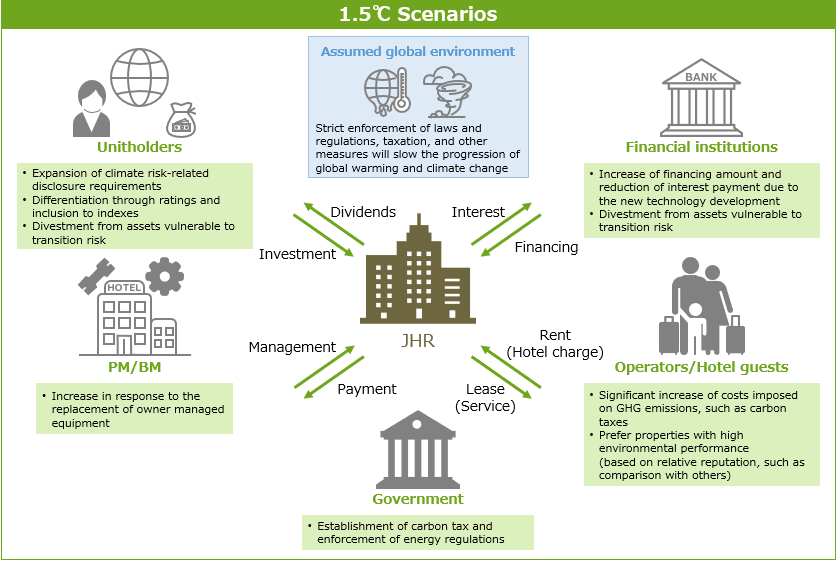
- 1.5℃ Scenarios:
- Various laws and regulations will be enforced to achieve a decarbonized society. Scenario with lower physical risks due to reduced greenhouse gas emissions compared to 4℃ scenarios, but higher transition risks toward a decarbonized society.
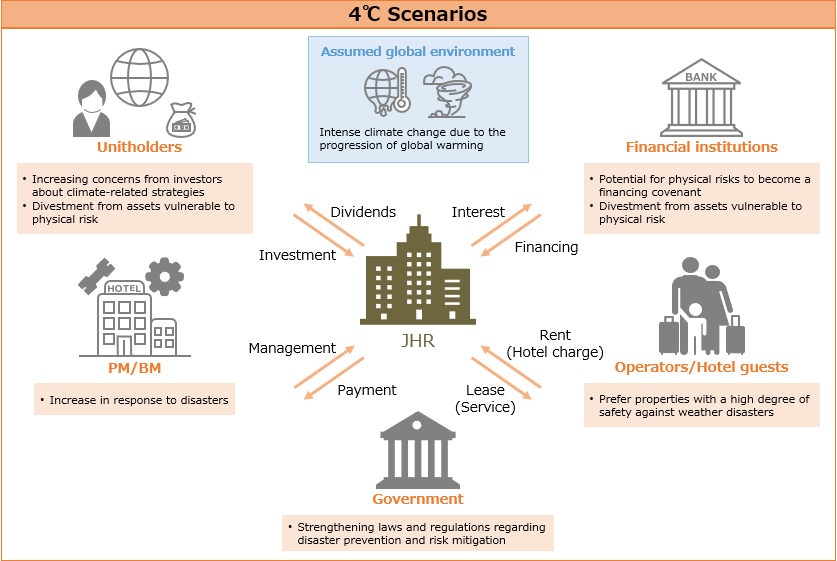
- 4℃ Scenarios:
- Enforcement of various laws and regulations to achieve a decarbonized society to be stagnant, and there is no significant change from the present state. The scenarios with high physical risk due to no reduction in greenhouse gas emissions compared to 1.5℃ scenarios, but low risk of transition toward a decarbonized society.
Climate-related risks and opportunities (short-, medium- and long-term climate-related risks and opportunities and financial impacts)
For each of the above 1.5℃ and 4℃ scenarios, we have evaluated the magnitude of the financial impacts on JHR which will be caused by the identified risks and opportunities. For each scenario, we evaluated the impact in the years 2025 (short term), 2030 (medium term) and 2050 (long term) on a scale of large, medium and small.
The accuracy of this assessment is not guaranteed, as it is a relative impact assessed based on a qualitative analysis and includes various factors such as uncertain assumptions and unknown risks over the medium to long term. A summary of the results is shown in the table below.
<Financial Impact Based on Scenario Analysis>
●Risk management
Premise of risk management (Identification and assessment of risks)
At JHRA, which is entrusted with asset management of JHR's assets, ESG Promotion Committee mainly plays a central role. ESG Promotion Committee identifies and assess climate-related risks as well as consider and decide business strategies to manage risks and countermeasures as one of the ESG issues. The processes of identification and assessment are as follows.
- Under the direction of the executive officer responsible for management of climate-related issues, an internal ESG team (hereinafter called "ESG Team"), which formulates goals, studies measures, and monitors their implementation status with respect to ESG-related issues, identifies and assess climate-related risks to JHR.
- ESG Team identifies and assess climate-related risks based on the classification of "Transition risks" and "Physical risks" and report the results (progress) at the ESG Promotion Committee.
- ESG Promotion Committee deliberates on climate-related risks and prioritized measures to manage climate-related risk which judged to be corresponded as priority based on the results of the ESG Team's identification and assessment of climate-related risks, including their potential to materialize and their financial impact and other factors. In addition, when climate-related opportunities are reported, the team prioritizes them within the business strategy.
For an overview of ESG Promotion Committee and ESG Team, please refer to "Sustainability Promotion System" within Sustainability Management.
Management of climate-related risks
The processes for managing the assessed climate-related risks are as follows.
- The executive officer responsible for management of climate-related issues will instruct the ESG team to formulate an action for the key climate-related risk factors that ESG Promotion Committee has decided to prioritize correspondence.
- Depending on its content, the action formulated by ESG team will be decided and implemented based on the necessary decision-making system within the asset management company including ESG Promotion Committee.
- Regarding the action decided on, ESG team summarizes the status of the progress and the impact by the action, and reports to ESG Promotion Committee. ESG Promotion Committee appropriately manages the risk through management of progress of the action and provide instructions on the formulation of new measures, etc. based on the report by ESG Team.
For an overview of Risk management, please refer to "Governance" within ESG.
●Metrics and targets
Based on the recognition that solving environmental issues represented by climate change is one of the most important management issues for stable medium- and long-term growth of the JHR, we are promoting low carbonization of our portfolio and energy use efficiency through environmental and energy-saving measures.
Greenhouse Gas (GHG) emissions
JHR has set a target to reduce GHG emissions intensity by 30% until 2050 (compared to FY2017) as a long-term goal.
Since the properties owned by JHR are managed by hotel lessees, etc. and their GHG emissions fall under Scope 3, Category 13, Leased Assets (downstream), the sum of direct emissions from fuel consumption (Scope 1) at the properties and indirect emissions from consumption of purchased electricity, etc., which converted final energy consumption into annual CO2 emissions (Scope 2) reported by the hotel lessees, etc. are used as GHG emissions for JHR.
The GHG emissions are calculated as follows.
-
Scope 1
CO2 emissions are calculated by multiplying the calorific value of each type of fuel (gas, heavy oil, kerosene, etc.) burned on-site by the "carbon emission conversion factor for each fuel type × 44/12."
-
Scope 2
Calculated only for electricity and the heat supplied from offsite sources (district heating and cooling, etc.). CO2 emissions are calculated by multiplying each consumption by the emission factor for respective suppliers or by the emission factor specified by the government.
Others
JHR is striving to reduce GHG emissions and take the following environmental measures and others at the properties it owns, aiming to build a portfolio that make reduction of environmental impact compatible with consideration of all stakeholders, including hotel guests.
- We have a plan in place to eliminate the use of specified CFCs (CFC) and alternative CFCs (HCFC, HFC) in short period by identifying the refrigerants used in the air-conditioning equipment of all properties owned by JHR.
- With regard to ODP and GWP, we aim to figure out the ODP and GWP of all refrigerants used in our properties.
- Upon renewal of air conditioning equipment, we make selection of equipment with consideration to ODP and GWP usage.